
Exhaust Repair in Redwood City: Noise, Fumes and Lost Power
If your car has got noticeably louder, you can smell exhaust fumes inside the cabin, or something is rattling under the floor, the exhaust system needs inspecting. Bring it to Five Points Tire and we will trace where the system is leaking, blocked, or broken loose.
Exhaust repair at Five Points Tire, in short
Five Points Tire inspects exhaust systems in Redwood City to trace where a system is leaking, blocked or broken loose. A car that has suddenly got louder, a rattle under the floor or the smell of fumes in the cabin all point somewhere specific, and a leak ahead of the cabin is treated as urgent. We have worked on El Camino Real since 1964.
Most exhaust problems announce themselves loudly, which is genuinely helpful.
The trouble is that loud feels like a nuisance rather than a warning, so people live with it for months.
Some exhaust faults really are just noise. Others are putting carbon monoxide near the cabin or quietly strangling your engine.
Here's how to tell which one you've got.
What your exhaust is actually doing
Your exhaust does three jobs at once: it carries toxic gases away from the cabin, it silences combustion, and through the catalytic converter it cleans up what the engine emits.
Forget the second two and a loud exhaust looks like a nuisance instead of a warning.
It also feeds the oxygen sensors that tell your engine how much fuel to inject, which is why an exhaust leak can show up as a running problem rather than a noise.
Front to back, here's the run:
- Manifold: Bolts to the engine and collects the gases. Cracks from heat cycling.
- Oxygen sensors: Read the gas and report back to the engine computer.
- Catalytic converter: Converts the nastier gases. Expensive, and a theft target on some models.
- Resonator: Cancels specific frequencies to take the drone out.
- Muffler: The main silencer, and usually the first thing to rust through.
- Tailpipe and hangers: Carry it and hold it up. Hangers snap, and then things rattle.
You cannot smell carbon monoxide. The smell that reaches the cabin is the rest of the exhaust. Carbon monoxide has no smell and no color, and it travels with it. If you can smell fumes inside the car, drive with the windows open and get it inspected rather than leaving it a few weeks.
Signs you need exhaust repair
- The car is suddenly much louder, especially when you accelerate
- A rattle or knock from underneath, worse over bumps or at idle
- You can smell exhaust inside the car
- A hissing or puffing noise that changes with engine speed
- The engine feels flat and fuel economy has dropped
- Visible rust, holes, or a hanging pipe under the car
Exhaust symptoms and what they usually mean
| What you notice | What it usually means | How urgent |
|---|---|---|
| Suddenly much louder under acceleration | A hole or failed joint in the system | Soon |
| Exhaust smell inside the cabin | A leak ahead of the cabin | Urgent |
| Rattle or knock over bumps | Broken hanger or loose heat shield | Book it in |
| Hissing or puffing that changes with revs | A leak close to the manifold | Soon |
| Flat, will not pull, especially uphill | Blocked catalytic converter | Soon |
| Check engine light with poor running | Exhaust leak upstream of an oxygen sensor | Soon |
A leak ahead of the cabin is the one to treat as urgent.
When a loud exhaust is a safety problem
A leak upstream of the muffler is the one to take seriously. A hole at the very back is annoying, but those gases are already past you. Position matters more than volume.
A leak further forward, near the manifold or under the floor, can find its way into the cabin through the firewall or the floor seals.
Exhaust contains carbon monoxide, and you cannot smell it or see it. What you can smell is everything else travelling with it.
So if you can smell exhaust inside the car, that's not a comfort complaint. Drive with the windows down and get it looked at.
| Where the leak is | What you notice | How urgent |
|---|---|---|
| Manifold or downpipe | Loud ticking when cold, fumes in the cabin | Urgent |
| Ahead of the oxygen sensor | Check engine light, worse economy | Soon |
| Under the floor | Drone, fumes in the cabin | Urgent |
| Muffler | Loud, deeper note, no smell inside | Soon |
| Tailpipe | Rattle or buzz only | Book it in |
Any fumes reaching the cabin move this straight to urgent, wherever they came from.
Exhaust rattles, and what they usually are
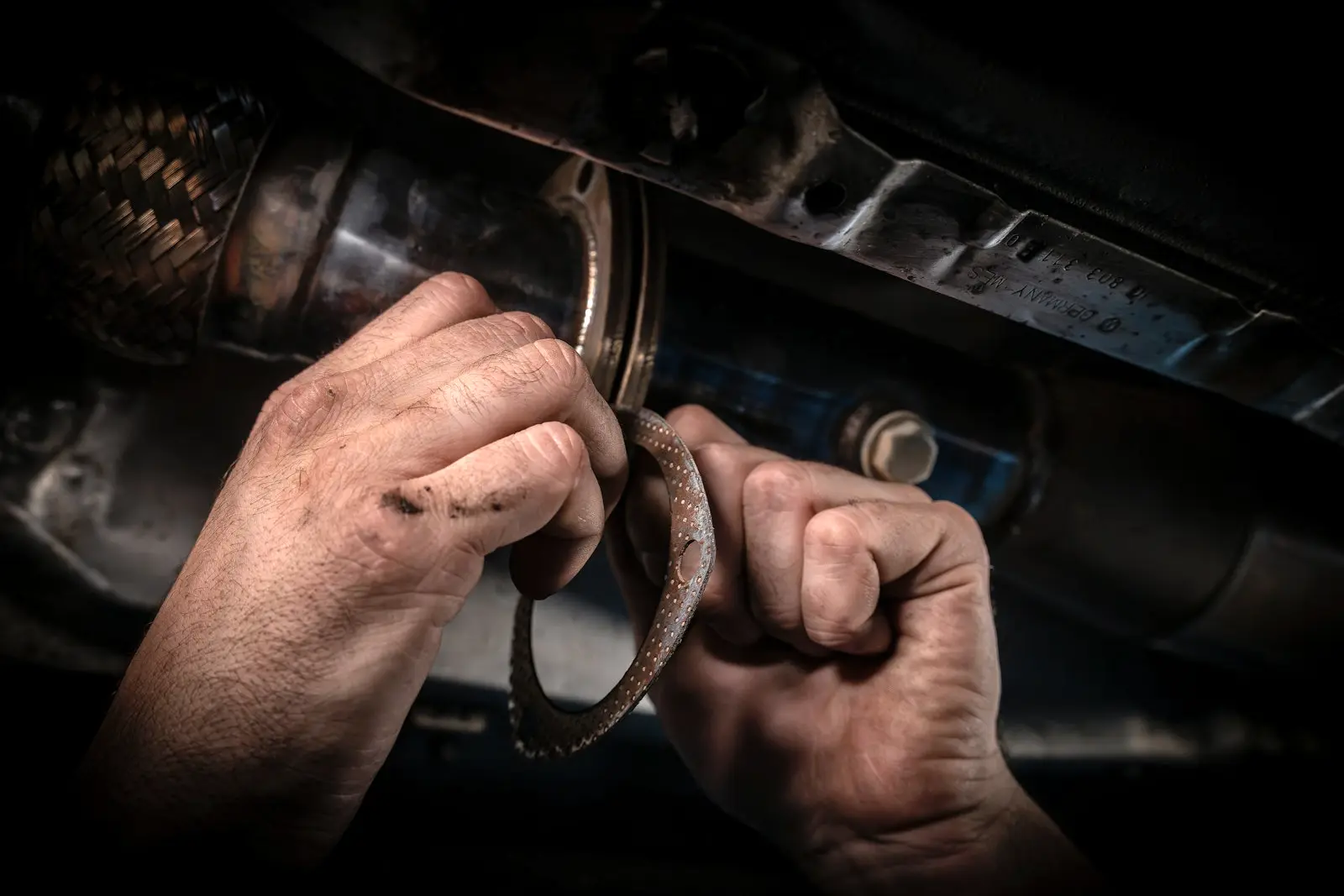
A rattle over bumps is usually a loose heat shield or a broken hanger, and both are cheap if you catch them early.
The catch-it-early part matters. Leave a broken hanger long enough and the pipe swings on its remaining mounts, which cracks joints and eventually breaks something that costs real money.
- Tinny rattle at idle, worse on bumps. Loose heat shield. Often the cheapest fix on the car.
- Clunk over bumps. Broken hanger letting the pipe knock the underbody.
- Rattle from the middle, like stones in a can. Catalytic converter substrate breaking up.
- Buzz that comes and goes with revs. Something touching the body and resonating at that frequency.
Want it checked? Describe what the car is doing and Five Points Tire will tell you whether it needs exhaust repair or something else. Call 650-365-0280, or send the form and someone calls you back. Request an appointment
How exhaust faults make your car run badly
An exhaust leak can make your engine run rich, idle rough and burn more fuel, because the oxygen sensors that set the fuel mixture live in the exhaust.
A leak ahead of a sensor lets fresh air in, the sensor reads more oxygen than there should be, and the computer adds fuel to compensate. You often get a check engine light for a fault that has nothing to do with the sensor itself.
A blocked catalytic converter does the opposite. The engine can't push exhaust out, so it can't draw fresh air in, and the car feels like it's lost its legs.
That one shows up worst when you ask for the most: merging, climbing, or fully loaded.
Common exhaust mistakes to avoid
- Treating fumes in the cabin as a smell problem. Carbon monoxide travels with the part you can smell, and you cannot detect it on your own.
- Living with a broken hanger. A supported pipe is a cheap fix. A pipe that has been swinging for months usually isn't.
- Replacing a catalytic converter without finding out why it failed. Converters rarely die of old age. A misfire or oil burning usually killed it, and it'll kill the new one too.
- Assuming a check engine light means a bad sensor. An exhaust leak ahead of the sensor produces the same code, and the sensor is fine.
- Ignoring a rattle from the middle of the car. That's often converter substrate breaking apart, and the debris can block the pipe further back.
The bottom line
Ask yourself two questions. Can you smell exhaust inside the car? And has the engine lost power?
A yes to either moves this up the list. Fumes in the cabin are a safety issue, and a power loss usually means something is blocked rather than just leaking.
If it's purely noise and nothing else changed, you've probably got a hole in the back half and some time to sort it out.
An exhaust fault rarely stays an exhaust fault. A failed Smog Check usually traces back to what is happening upstream, and a rich mixture eating a converter often starts at the fuel injectors, which is the point at which diagnostics earns its keep.
Either way, bring it to Five Points Tire at 2115 El Camino Real and we'll trace where it's actually leaking rather than replacing sections on a guess.
Why has my car suddenly got so loud?
- Almost always a hole or a failed joint in the exhaust, most often at the muffler or where two sections meet. The sound is combustion noise escaping before it reaches the silencer. Worth checking promptly, because a leak that started at the back can be somewhere further forward than it sounds.
Is it dangerous to drive with an exhaust leak?
- It can be. A leak ahead of the cabin can let exhaust gases inside, and those contain carbon monoxide, which has no smell or color. If you can smell fumes in the car, open the windows and have it inspected rather than leaving it for a few weeks.
Can a bad exhaust cause a check engine light?
- Yes, frequently. The engine computer sets the fuel mixture using oxygen sensors mounted in the exhaust, so a leak upstream of a sensor gives it a false reading. A failing catalytic converter also sets a light of its own.
What does a rattling noise under the car usually mean?
- Most often a loose heat shield or a broken exhaust hanger, which lets the pipe knock against the underside of the car over bumps. Both are far cheaper to fix while the pipe is still supported than after it has been hanging on one mount for a while. Five Points Tire traces a rattle to the specific hanger or shield rather than quoting a whole section.
Related services
Check Engine Light
A check engine light means the engine management system has stored a fault code, and the code narrows down where to look rather than telling you what to replace.
Smog Check Repair
If your vehicle has failed its California Smog Check, or the check engine light is on with a smog test due, the underlying fault has to be found and repaired before it can pass.

Diagnostics
Modern vehicles record faults across dozens of electronic modules, and a proper diagnosis reads that data and then tests to confirm the cause rather than guessing from the code.
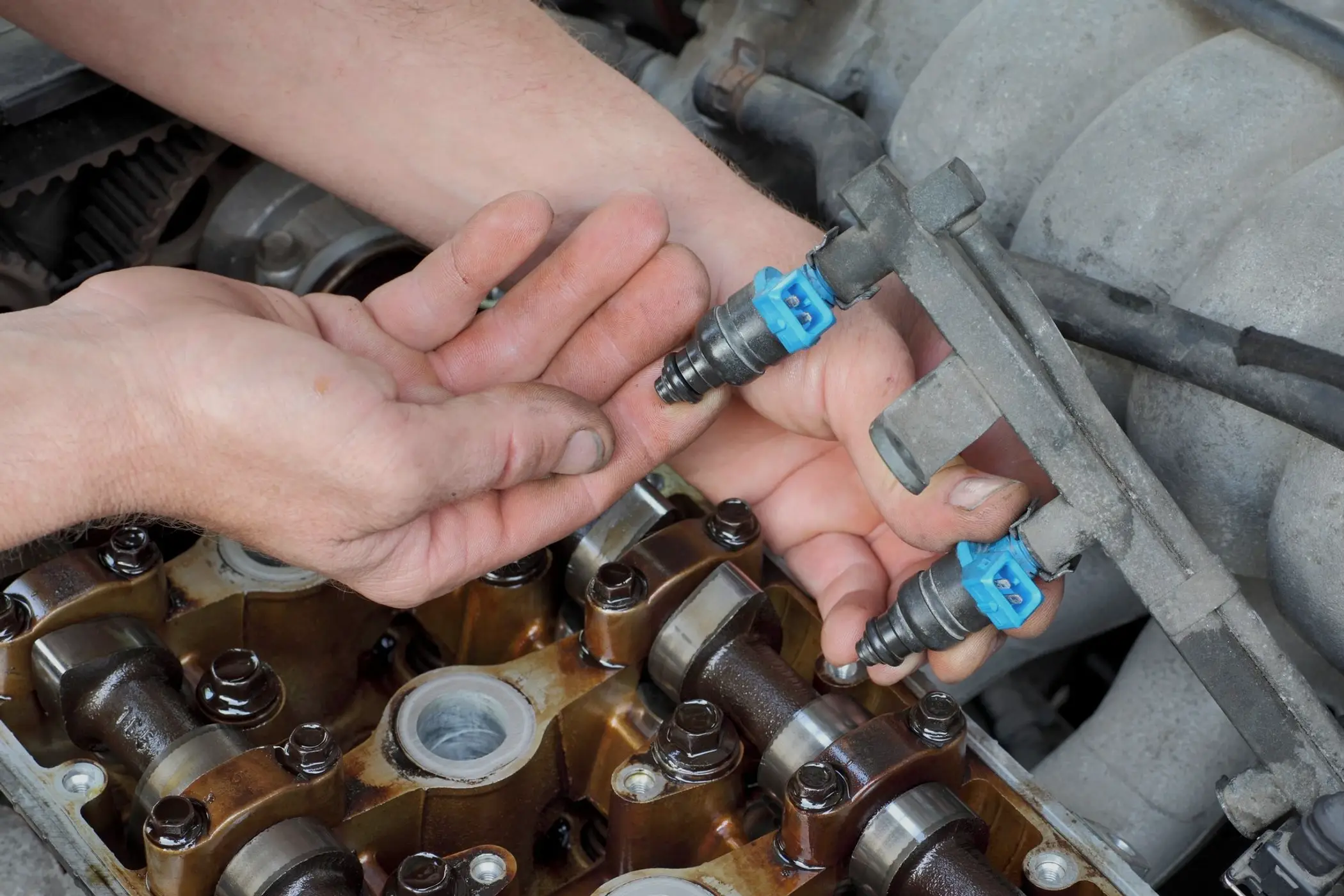
Fuel Injectors
Fuel injectors spray a precisely metered, finely atomised mist of fuel into the engine, and when their nozzles foul the spray pattern degrades and the engine misfires, runs rough and drinks more fuel.
Vehicle Tune-Ups
A tune-up replaces the ignition and filter parts that wear out: spark plugs, ignition coils, air and fuel filters, and the PCV valve.

State Inspection Rules
California does not have a periodic vehicle safety inspection, so there is no annual or biennial safety certificate to obtain here as in many other states.